
Technical Analysis Guide P.3 → The Cup and Handle Pattern
Learn More To Earn More (free)

Part 3 of a free, ongoing series breaking down key indicators, chart patterns, and trading strategies to help everyone better understand the market 🤝
Cup & Handle is one of the most reliable and widely recognized bullish continuation chart patterns in technical analysis. It signals that after a period of consolidation and mild correction, a stock is likely to resume its prior uptrend with strong momentum.
History and Creator:
The Cup & Handle pattern was popularized by William J. O’Neil, a legendary stock trader, founder of Investor’s Business Daily (IBD), and creator of the CAN SLIM investing system. He first detailed it extensively in his 1988 bestselling book How to Make Money in Stocks. O’Neil spent years studying the charts of the biggest winning stocks of the past century and identified recurring patterns that preceded major price advances. The Cup & Handle was one of the most consistent setups he found in high-performing growth stocks.
It became extremely popular in the 1990s and 2000s through IBD’s charts, O’Neil’s seminars, and the rise of technical analysis among retail and institutional traders. The pattern’s visual simplicity, combined with O’Neil’s proven track record (he turned a small account into millions), made it a staple in growth-stock trading literature and software.
What’s the pattern?
The Cup & Handle forms during an existing uptrend and consists of two main parts that resemble a teacup with a handle on the right side:
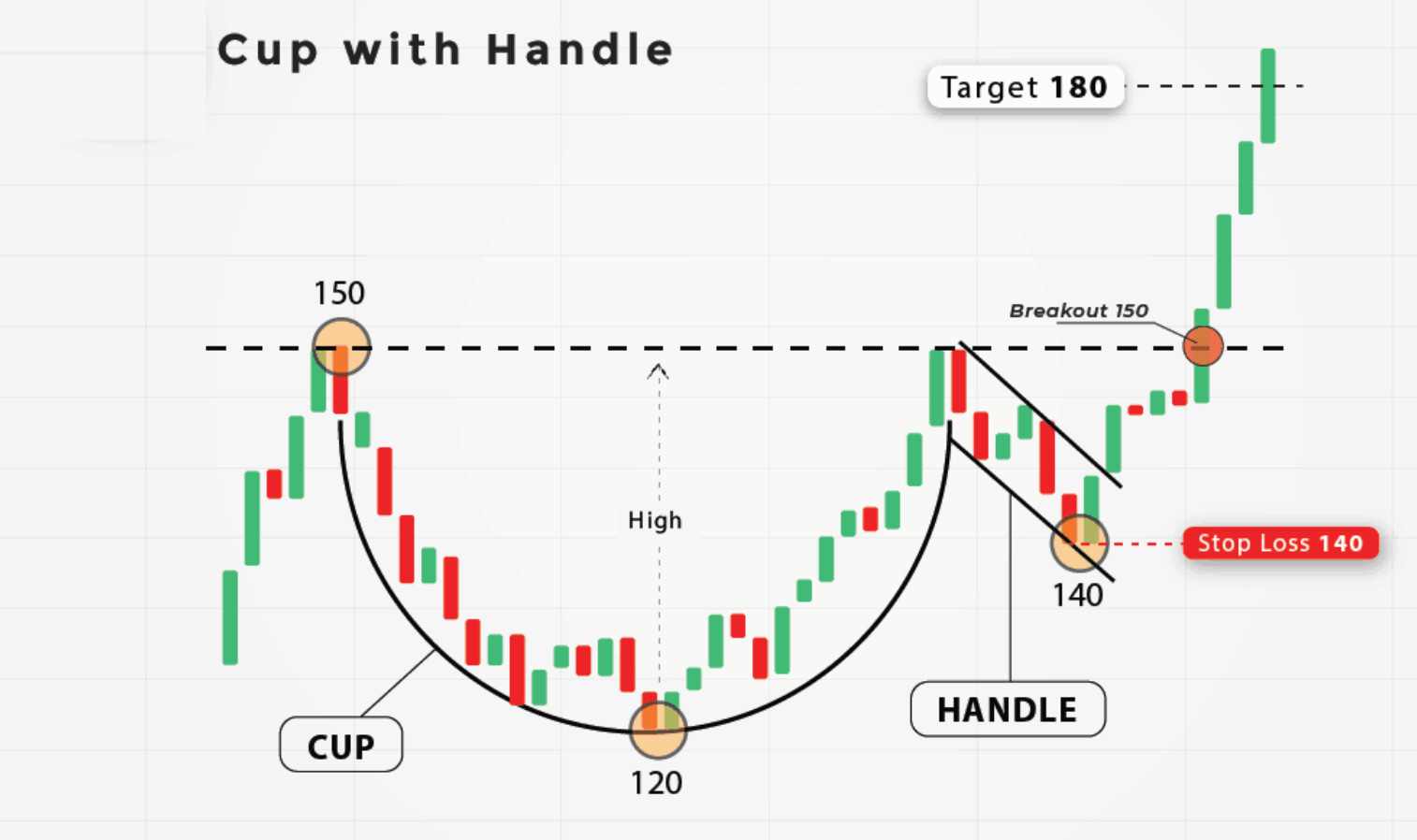
The Cup (rounded bottom): Price declines gradually from a high, bottoms out in a smooth U-shape (not a sharp V), and rises back to near the prior high. Ideal depth is 12–33% (shallower cups in strong bull markets perform best). Duration: typically 7–65 weeks
The Handle (consolidation): After the cup completes, price pulls back slightly (usually 8–15% or less) in a tight, downward-sloping or sideways channel that lasts 1–4 weeks. Volume should dry up during the handle
The Breakout (trigger): Price breaks above the resistance line with an increase in volume. This confirms the pattern and launches the next leg up
Ideal characteristics (O’Neil’s criteria):
Prior uptrend of at least 30% before the cup forms
Rounded cup (gentle decline and advance)
Handle drifts down but stays above the midpoint of the cup
Breakout on strong volume (at least 40–50% above average)
What is a template?
Templates are reusable content blocks you can insert into any post. Use them for content you repeat often, like:
Standard disclaimers or disclosures
Calls to action (subscribe, share, etc.)
Custom dividers or recurring sections
Post templates or boilerplate
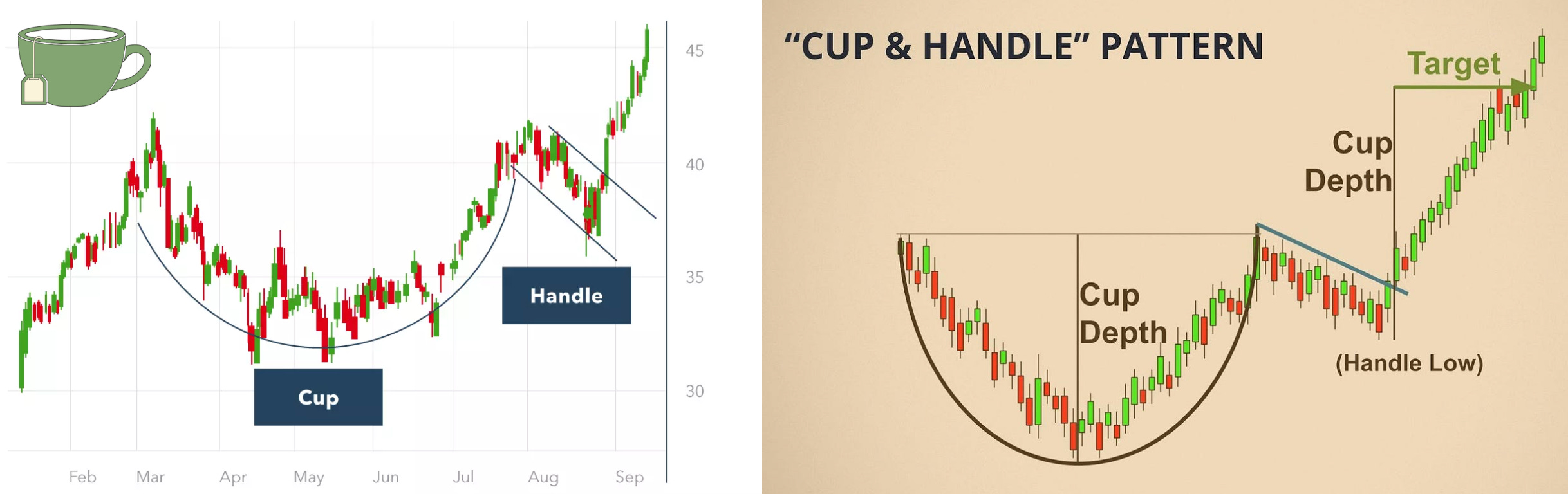
When the Pattern Works Best:
In strong bull markets with a healthy overall market trend
On high-quality growth stocks with excellent fundamentals (earnings growth, sales acceleration
When the cup is symmetrical and the handle is short/tight with low volume
On daily or weekly charts → Large timeframes ALWAYS trump small time frames!
Does NOT work best:
Has a high failure rate in bear markets or weak overall market conditions
When the cup is deep (>50% or V-shaped) or the handle is too long/deep
Low-volume breakouts
On low-float or manipulated stocks without institutional interest
Statistics
The Cup & Handle is one of the higher-probability chart patterns when formed correctly:
Success rate (price continues higher after breakout): 70% (1-year horizon) → 80% (5 years) → 85% (10 years) in backtested studies
Post-breakout moves frequently deliver 20–50%+ gains within weeks to months in strong setups (some explosive winners exceed 100–300%)
O’Neil and followers have documented hundreds of historical examples where the pattern preceded major advances in market leaders
These are not “guaranteed” results → they come from historical studies of formed patterns in bull markets. Individual trade win rates will be lower once you apply stops and realistic exits, but the risk-reward is often excellent (many traders target the depth of the cup projected upward from the breakout).
How to Trade the Cup & Handle PatternStandard rules (O’Neil-style):
Entry: Buy on the breakout above the handle’s resistance line (pivot point). Some traders wait for a close above it or a slight pullback retest for better confirmation.
Stop Loss: Place below the lowest point of the handle (or sometimes slightly below the cup low in deeper patterns). Typical risk is 8–12% from entry.
Profit Target:
Classic measured move = depth of the cup projected upward from the breakout point.
Many traders scale out in stages or trail stops using moving averages or swing lows.
Risk management tip: Never risk more than 1–2% of your total account on any single trade. The pattern’s strength comes from its asymmetry — winners can be very large, while losses are contained by the clear stop level.Here are real-world chart examples showing the Cup & Handle with breakout and follow-through:
The Cup & Handle remains one of the most respected bullish continuation patterns because of its strong historical track record in leading growth stocks. It combines price action, volume, and time in a visually intuitive way. As with all patterns, success depends on market context, proper formation, and strict risk management — but when everything aligns, it can deliver some of the most powerful and profitable moves in the stock market. Always confirm with fundamentals and broader market conditions
- KR
Reminder: This is not financial advice. These are my trade ideas and you should do your own research before taking any trades. I provide the daily trade ideas I am watching. It is up to you to read them and form your plan on how you want to trade them.Disclaimer:
This is my personal analysis and is not to be taken as trading advice. I am not a professional nor am I licensed with anything associated with the Stockmarket. Trading involves risk and you WILL LOSE MONEY. Everyone has a different risk tolerance, portfolio size, and style of trading. It is important to trade within your comfort.
Hi my brother signed up for a subscription he’s having trouble geting on his name is Donnie Deagle