
Technical Analysis Guide P.4 → Single-Busted Double Top Pattern (Bullish)
Learn More To Earn More (free)

Part 4 of a free, ongoing series breaking down key indicators, chart patterns, and trading strategies to help everyone better understand the market 🤝
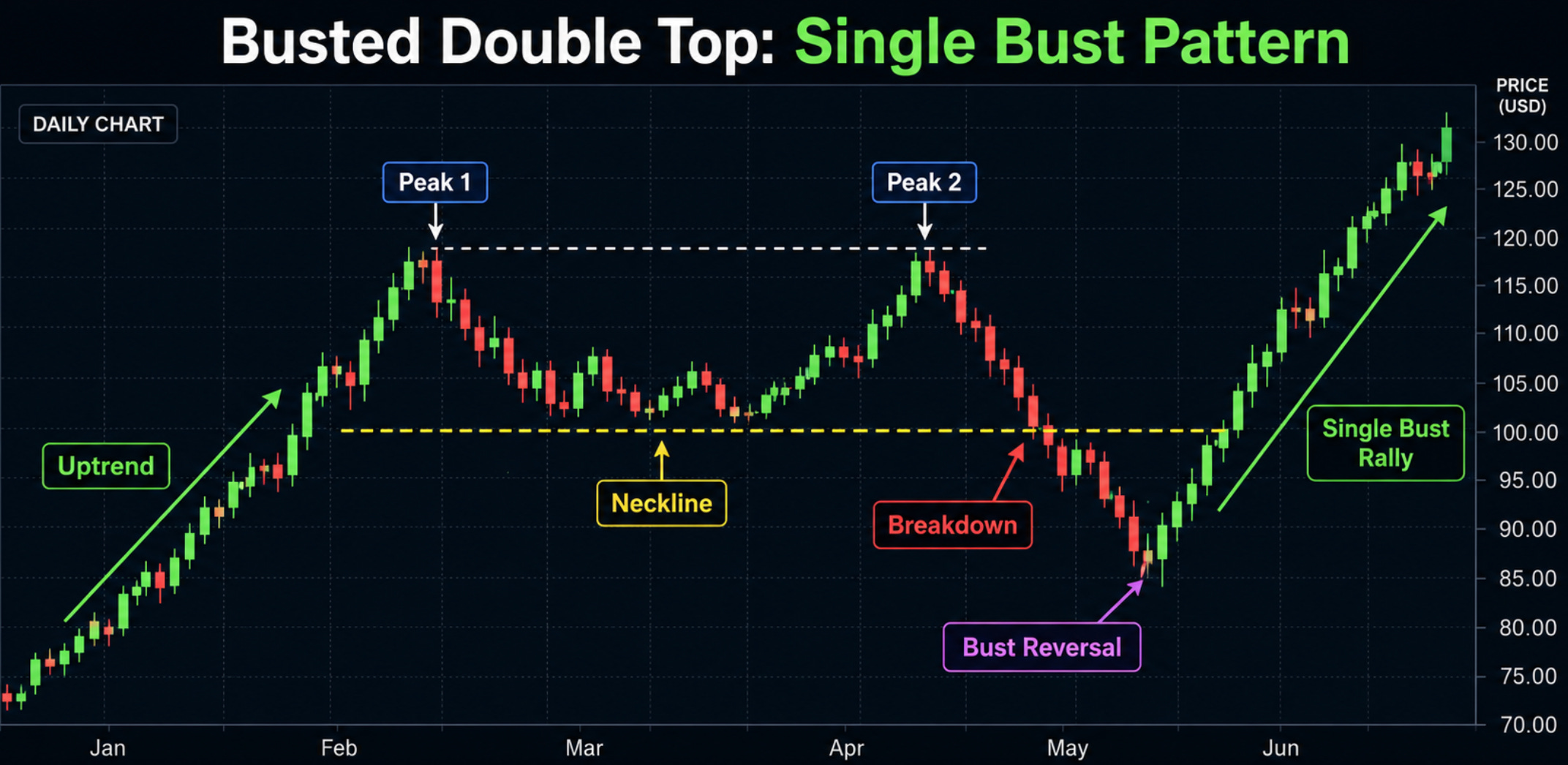
Single-Busted Double Top is a high-probability bullish reversal chart pattern that forms when a classic bearish Double Top “fails” in a very specific way. After the Double Top confirms with a breakdown below the valley (neckline), price drops only a short distance (no more than 10%) before reversing sharply higher and closing above the original peaks. This single bust turns what looked like a reliable bearish signal into a strong bullish opportunity.
History and Creator:
The “busted pattern” concept, including the single-busted Double Top, was developed and statistically validated by Thomas N. Bulkowski in his Encyclopedia of Chart Patterns. Bulkowski analyzed millions of price bars on U.S. stocks and isolated cases where bearish patterns failed quickly, creating powerful moves in the opposite direction. Single-busted Double Tops stood out in his data as one of the strongest performers among failed patterns, which is why they remain a favorite among pattern traders who follow his research.
What the Single-Busted Double Top Is 👇
It starts exactly like a normal Double Top (two peaks at roughly the same price level after an uptrend, connected by a valley). It only becomes a single-busted pattern when the following sequence occurs:
Price confirms the Double Top by closing below the valley low (neckline)
Price then declines no more than 10% below that confirmation point (this limited drop defines the “single bust”)
Price quickly reverses and closes above the highest peak of the Double Top
The brief downward move after confirmation traps early sellers, but the rapid recovery shows sellers are exhausted. Single-busted versions make up 67% of all busted Double Tops and deliver the cleanest, most reliable reversals.
When the Single-Busted Double Top Works Best:
In bull markets or strong uptrending environments
After a moderate (not extremely extended) uptrend
When volume slows sharply on the brief downward breakout and then increases on the upward reversal
On daily or weekly charts
When the downward move after confirmation is shallow (well under 10%)
Does NOT work best:
In strong, extended bear markets
When the initial drop after neckline break exceeds 10% (it becomes a valid Double Top instead of a bust)
Performance Statistics → Bulkowski’s data is exceptionally bullish for single-busted Double Tops:
67% of all busted Double Tops are single busts (the best-performing variety)
Average rise after the upward bust: 54%
These rank among the top reversal setups in his entire database because the failure of the bearish pattern draws in aggressive buying
The limited downside (≤10%) after confirmation keeps risk very contained, while the follow through on the reversal side is often powerful.
How to Trade the Single-Busted Double Top:
Entry (Long): Buy when price closes above the highest peak of the double top confirmation
Stop Loss: Place a penny below the lowest low reached during the brief post-confirmation drop (usually the neckline or the lowest point of the bust). Risk is naturally tight because of the ≤10% rul
Profit Target / Exit:
Measured move: Height of the original Double Top projected upward from the bust breakout point
Trail stops using swing lows or a moving average
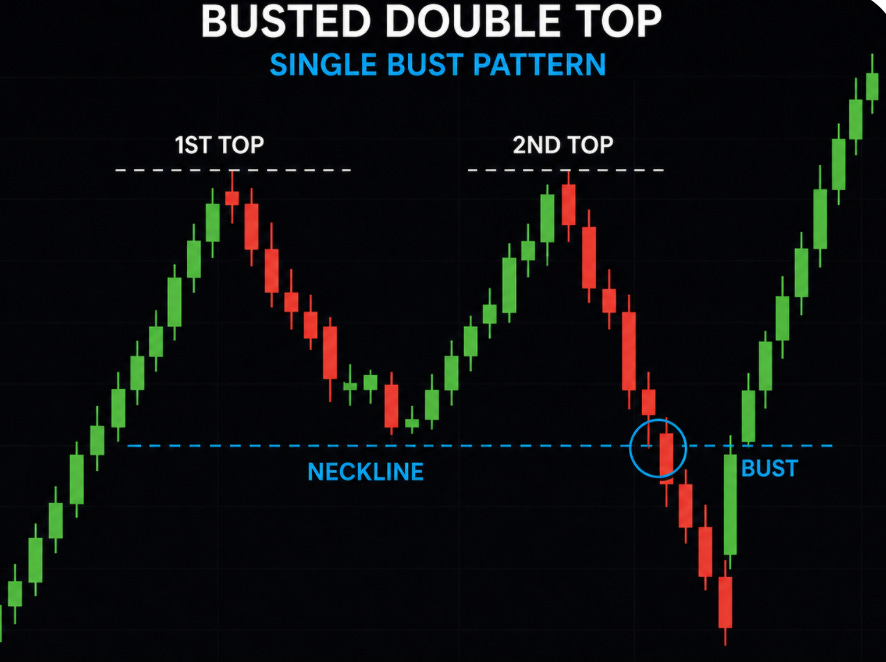
Psychology: The initial neckline break lures bears in, but the shallow pullback and explosive recovery reveal that smart money was accumulating on the dip. Volume confirmation on the upward close adds conviction.
Tips for single-bust trades:
Wait for the full bust to form (close above the peaks)
Combine with broader trend filters (price above 200-day EMA)
Because single busts are less common than regular patterns, be patient! The R/R is worth it when they appear
- KR
Reminder: This is not financial advice. These are my trade ideas and you should do your own research before taking any trades. I provide the daily trade ideas I am watching. It is up to you to read them and form your plan on how you want to trade them.Disclaimer:
This is my personal analysis and is not to be taken as trading advice. I am not a professional nor am I licensed with anything associated with the Stockmarket. Trading involves risk and you WILL LOSE MONEY. Everyone has a different risk tolerance, portfolio size, and style of trading. It is important to trade within your comfort.